Friday, April 29, 2011

SOS Is the market rationale?


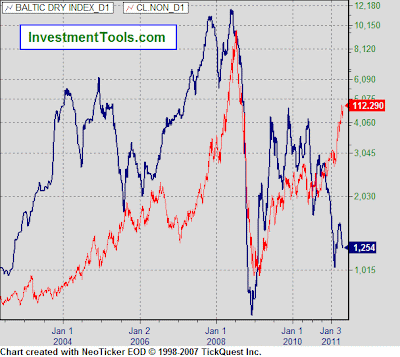
BDI is currently at 1254 and the peak is about 12,000 in early 2008.

Don't bother trying to use fundamental to explain the financial markets, it is emotional, not rational.

Oil price goes up, share market should drop right?
BDI indicates the economic activity right, why market up when economic activity is down?


MyView

I am not saying fundamental is not useful, or technical, for the matter, economic cycles, all are important tools to evaluate the stocks. However, the price and volume of the stocks is the behavior of all participants, from experts and non-experts. Whichever way we analyse it, they follow certain mentality, called HERD MENTALITY. Never change, never will, period.

Well, the funny part, there is always 2 schools of thoughts (at least) in evaluating the financial markets. There must be something lacking in the books, economics is like a mysterious subject. It is neither science nor art.

The most followed guru in investment in shares is non other than Warren Buffett. But lately, he has been tainted by his involvement with Goldman Sachs and Sokol. Like he said, it takes years to acquire the reputation but take seconds to destroy it.

SOS Can US sustain without QE3?


Bernanke says..... on 28 April 2011


"The conclusion that the second round was ineffective could be validated only if someone thought this was a panacea (one that cures all)" he says. "Relative to what we expected, anticipated, the programme was SUCCESSFUL".

Bernanke makes clear that there will be no QE3.

So why not do more? "The trade off is less attractive"


MyView


"Trade off is less attractive" refer to political and inflation pressure. Now, I think the fund will begin between June to October. First time, the drug addict without the drug. Not sure what will happen, but it will be interesting to observe. If the dossage is strong enough, it will last a bit longer.


By the way, how is US housing and employment doing? Are they out of the woods? I really hope so, couple with gasoline at $4 per gallon, and high commodities prices, taxpayers may be hard hit. It could be worse, I guess if they stopped QE2.


I believe one cannot stop the tsunami, but can reduce the impact by having walls. Then again, the money spend on building the wall (misallocation of resources) has its side effects. No one can actually stop the tsunami. It may even build up a bigger one.

Wednesday, April 27, 2011

SOS FIsher's Theory of Deflation Depression

Assuming, accordingly, that, at some point of time, a state of over-indebtedness exists, this will tend to lead to liquidation, through the alarm either of debtors or creditors or both. Then we may deduce the following chain of consequences in nine links:

(1) Debt liquidation leads to distress selling and to
(2) Contraction of deposit currency, as bank loans are paid off, and to a slowing down of velocity of circulation. This contraction of deposits and of their velocity, precipitated by distress selling, causes
(3) A fall in the level of prices, in other words, a swelling of the dollar. Assuming, as above stated, that this fall of prices is not interfered with by reflation or otherwise, there must be
(4) A still greater fall in the net worths of business, precipitating bankruptcies and
(5) A like fall in profits, which in a “capitalistic,” that is, a private-profit society, leads the concerns which are running at a loss to make
(6) A reduction in output, in trade and in employment of labor. These losses, bankruptcies and unemployment, lead to
(7) Hoarding and slowing down still more the velocity of circulation.

The above eight changes cause (9) Complicated disturbances in the rates of interest, in particular, a fall in the nominal, or money, rates and a rise in the real, or commodity, rates of interest.

(don't ask me where is cause #8, it is extracted from www.londonbanker.blogspot.com)

MyView

Whatever that is over expanded will contract (we do not need Paul Krugman, Roubini, Jim Rogers or Fisher to tell us that).

The credit expansion since the 1930s till 2010 in USA, almost 70 years is called OVER EXPANDED in credit (not printing of physical money) and it had come to a very dangerous level that any financial ratio can measure.

In 'pop' in 2008, and the Fed and US Government did what it is suppose to do, REFLATE the economy, or they will lose their jobs. So, 2009, 2010 and 2011, they have used almost all tricks they know: Bailouts, Stimulus, QEs, changing accounting policies, zero interest, mismanagement of regulators, rating agencies. How long can this goes on, until their sovereign debt pop?

And, if they are 'cunningly clever', they may buy lenders may buy themselves another year, then, comes DEFLATION (i.e. credit contracts).

So there you go (for fun only) :

Credit Creation - INFLATION (1970 to 2008)
Intervention - REFLATION (2009 to 2011/2)
Credit Contraction - DEFLATION (2013 to 2015)
after which

War - later on after war, HYPER INFLATION (2016 onwards)

I hope I got the sequence right. A lot of experts jump straight into Hyperinflation, which what USA hope for, paying back the debtor with toilet paper, which they wish.

Tuesday, April 26, 2011

SOS How is Malaysia doing statistically?


MyView


GDP grow from USD75 bil to USD200 bil from 1995 to 2010 (increase USD125bil)

Credit grow from USD80 bil to USD300 bil from 1995 to 2010 (increase USD220 bil)

Generally, GDP credit grow 1.76 times per GDP. This is inconclusive, but it does show that our GDP is driven up mainly from credit creation.


Market cap in US dollar bearly back to 1996/7 level, after 15 years.


SOS Life is getting harder in Malaysia?


Food (p.a.) 1500 4500(3X)
Petron (R97 per litre RM) 1.00 2.70(2.7X)


By Kenny Gan, Malaysia Chronicle


I started working as a young graduate electrical engineer in 1983 in an engineering firm in Kuala Lumpur. My starting salary was RM1200 which was pretty typical in those days. This may not seem much now but mixed rice was less than RM2.00 with Chinese tea and petrol was RM1.00 a litre.


After 6 months and an increment under my belt I plonked down for set of wheels; a cute little Toyota Corolla which I paid off in 3 years.


Two years later I put down the deposit for a double storey terrace house in a thriving suburb near the capital.Fast forward to the present and it would be very hard for any graduate to follow my act without substantial help from their parents. No, I wasn’t from the privileged class and I didn’t get a leg-up from my parents, save for the education they gave me.


Present day graduates start their working life at RM1800 to RM2000 a month, not a lot of difference from 25 years ago but prices of everything have tripled and quadrupled. A hawker meal now cost RM5 (drinks extra), prices of cars and houses have grossly outpaced income and there are new expenses like toll, hand phones, Astro and internet.


Our ringgit has depreciated against foreign currencies making consumer goods and overseas travel more expensive. To put it simply, real income has declined.


Today we find that graduates have to ride motorbikes if their parents do not help them buy a car. A car loan has to be stretched to 8 or 9 years just for a basic family car. The middle class is burdened by high car loans which they have little choice due to the stunted public transport. We find couples who are both working graduates lamenting that they cannot find any house within their means. Many of them have to get help from their parents to pay the house deposit. Unfortunately they will have nothing to give a helping hand to their children in future.


At the lower end of the labour market things are no better. From 1985 to 1995 salaries for factory workers, manual workers, office staff and the like increased by about 50% but they have stagnated for the past 15 years. Today our factories are filled with foreign workers because local workers are unable to survive on wages of RM700 a month which will be wiped out by transport and rental alone. Are they expected to spend all their free time working overtime just to earn enough to eat?Employers decry that locals are not interested but our workers are expected to survive on wages which were marginal even 15 years ago even though prices of goods and services have more than doubled since. We should note that if the salaries of the lower level cannot go up neither can the salaries of the upper level so the masses of foreign are also keeping the salaries of professionals depressed.


Going backwards


There are few countries where life gets harder as the years pass but Malaysia is one of them. In a healthy country it is more usual for the standard of living to improve from generation to generation. In Australia graduates are buying houses earlier then before despite the rise in prices and they holiday overseas before they graduate. Even traditional basket cases like the Philippines stay the same if they do not improve. A declining standard of living is the usual province of failed states like Zimbabwe, Congo and Myanmar.Compared to countries like Singapore, Hong Kong, Taiwan and South Korea which were on the same footing as us in the 1970s, Malaysia’s economic progress has been dismal.


Today, they have left us far behind despite lacking our advantage of rich natural resources. Singapore is now a first world country with per capita income of 5 times ours, Hong Kong is 4 times and Taiwan and S. Korea about 2.5 times. The value of our ringgit has depreciated from RM2.00 to USD1.00 in the early 1980s to RM3.20 today while their currencies have appreciated substantially.


Malaysia’s economy has indeed been growing at 6%-8% a year for most of the past two decades. But GDP growth figures do not translate into general economic wellbeing as the disparity in income between the haves and the have-nots has moved steadily wider. According to the Gini coefficient which measures the inequality of income distribution, Malaysia has the worst income disparity in Asia. Wealth is being created but they mostly end up in the hands of the politico-business elite while corruption robs the poor and middle class to give to the rich.


What went wrong with Malaysia?Authoritarian governments like Singapore, Taiwan and South Korea can still generate economic progress and uplift the standard of living of their citizens so what went wrong with Malaysia? Do they have something we lack or is it due to something we have that burdened us?If there is any one reason which is the mother of all reasons for Malaysia’s lacklustre performance it is racial policies which has replaced meritocracy, encouraged rent seeking practices, resulted in economic inefficiency and distortion, pulled down education standards, caused a brain drain and become a vehicle for wastage and massive corruption.


They are also responsible for dampening the human spirit required to drive the economy forward.The role of corruption in regressing living standards cannot be understated. Corruption is basically a re-distribution of wealth from the poor and middle class to the rich. The plunder of public funds eventually means higher direct and indirect taxes like GST and higher charges for public services. Unfair negotiated sweetheart deals between the government and cronies such toll concessionaires, IPPs and water supply are passed to the man in the street to foot the bill by paying higher tariffs.Protectionism for an ill-advised car industry has saddled the middle class with paying high prices for shoddily built cars while favoured cronies laugh all the way to the bank. Consumers have to grapple with external inflationary pressure from world commodities and internally generated inflation to feed cronies.


Where to, Malaysia?


Najib’s NEM (New Economic Model) contain lofty aims to lift Malaysia to a high income country but it does not address the structural problem of efficiency sapping racial policies, endemic corruption low education standard and dependency on foreign workers. Oppression of democratic rights and subjugating the independence of law enforcement institutions like the judiciary, police and MACC also keep investors away. Without the political will to institute real reforms whatever snazzy economic plan rolled out will become an extension of the NEP and fail.As real income continue to decline in the face of stagnated wages and increasing inflation the standard of living will keep going down. What happens next is predictable. If our graduates cannot make a decent living here they will go overseas to look for work. Following their heels will be masses of Malaysians looking for work as maids, waiters and unskilled labourers.


We will become a maid and labour exporting country like Philippines and Indonesia.As long as BN continues to rule there will be no meaningful reforms to uplift the economy and living standards of the common people. What the country needs is a new government which can discard the racial baggage of the past to drive Malaysia forwards. The alternative is a maid exporting country and by 2020 instead of a high income country.


MyView


GDP is overated, period. Standard of living includes, education standards, crime rate (every part of PJ is either guarded or gated or both, increase cost of living and fear of crime), cleaniness, lack of corruption, fairness in government policies, reasonable justice in court, meritocracy, effective execution of law etc. This is not saying other countries do not have or share the same problems, it is COMPARATIVE.


Taking away our natural like oil and palm oil, I am wondering what will happen to Malaysia.

Sunday, April 24, 2011

SOS Genocide in USA


  1. Genocide on the American citizens.

  2. Collapse of the US Treasuries.

Fiat Money is paired. US-Euro, US-Yen, US-Yuan, Euro-Yen, Euro-Yuan. It is basically a tug of wall. All of them has been printing since the crisis of 2008. I believe all of these currency will have a zig zag pattern against each others, due to the fact of credit implosion at a different time.


What the traditional money like GOLD. All of them will be depreciated against gold eventually, in the long run, like what the US dollar, which has dropped more than 97% in the last 70 years. However, there will be a catch, how would any of them collapsed? It had to collapsed against another currency.


So, one can argue that, if your rating is cut, hence, the confidence issue will arise. So, let us say, USA's AAA rating is cut to just an A (we know it is worst than junk bond), so it will force everyone to dump US dollar. However, the unfortunate part is that when you dump a currency, you will have to be against another currency, what would you buy then, Yen? Sterling? Euro? or perhaps gold? Brilliant idea, since gold is real money (with limited supply) why not everyone just convert their US dollar into gold. But at the moment, gold is only worth on paper USD7 trillion and world's wealth in about USD125 trillion. So, gold price will have to explode, from US1500 to US15000 per oz?


Will it be possible, then everyone will trade with GOLD? In such a case, what about Euro, will it shoot up to the moon, since US dollar collapse. The next question we ask, is Europe economically more sound than USA? They are not far off.


So, how would we explain the Collapse of US dollar. We do know, the end game that US dollar will be a toilet paper, so is Euro and so is Yen.


MyView


Problem with experts nowadays, they only explain one side of the coin. And of course, some hide the other side of the coin. But the world has not really seen how a credit implosion looks like, Japan experience it for the last 15 years, they are still in denial.


We know that US have trillions of bad debt that is yet to implode, what will happen if it burst? This is a trillion dollar questions. But Thomas Jefferson did said about the credit creation, first it will cause INFLATION and ultimately DEFLATION. The question now is inflation comes about from credit creation, and deflation comes about from credit implosion. Which is the like scenerio going forward?


Saturday, April 23, 2011

SOS Illusions and Delusions


The truth is out there.


It cannot be denied that we are living in illusion and delusion.


Something appears to be one way, but the actual truth is far from what it appears. That is why our forefathers said, never judge a book by its cover.


A lot of things are base on perception. Politics is based on perception. Truth are twisted and manipulated to justified an end. We have seen too much in this country and so are other countries. Truth is not important, unless it can gain political milage.


MyView


It is a chaotic world out there. Truths can be lies, lies can be truths, depends how do we perceive them. We can live in a better world if we practice truth, compassion and forebearance.